

A Voice of the Past Inspiring A Voice of Today: Beyonce & Huddie
There are moments in a concert that stop time.
Not the fireworks. Not the costume change. Not the pyrotechnics or the levitating platform or the mechanical bull. The moments that stop time are the quiet ones — the ones you weren’t expecting, the ones that reach past the spectacle and grab you somewhere deeper.
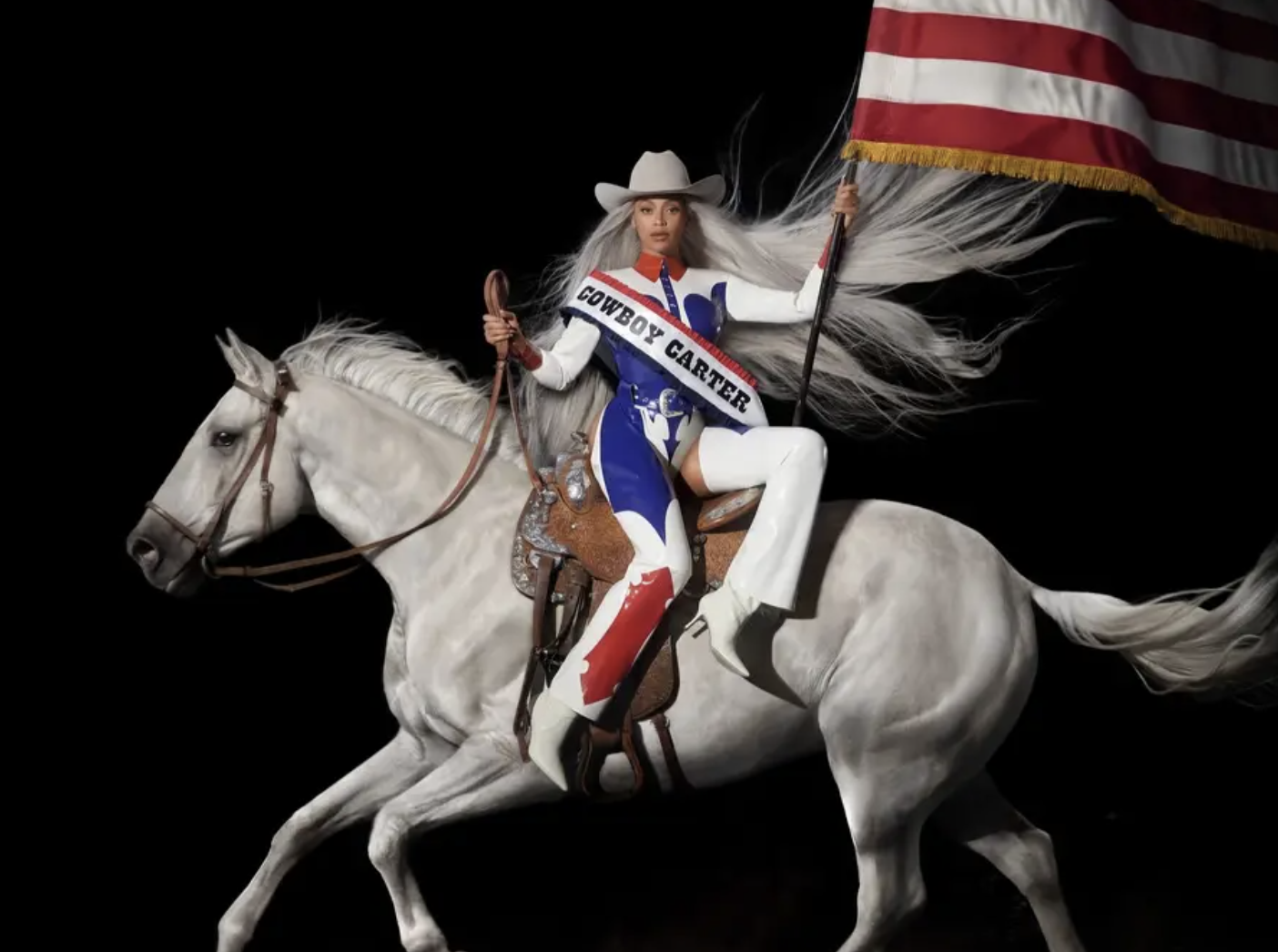
On the Cowboy Carter and the Rodeo Chitlin’ Circuit Tour — Beyoncé’s tenth concert tour, which ran from April through July 2025 — one of those moments came about an hour into the show. The stadium went dark. And then, cutting through the silence, came a voice most of the audience had never heard before.
Raw. Rhythmic. Old. Real.
It was Huddie Ledbetter. Lead Belly. The King of the 12-String Guitar. Filling a stadium in 2025.
His rendition of the work song “Looky Looky Yonder” — part of a medley he often performed alongside “Black Betty” and “Yellow Women’s Doorbells” — served as the live introduction to Beyoncé’s “Alliigator Tears,” Cnwmedia a warm, sharp song about respectability politics and whose standards have always been allowed to define American culture.
Beyoncé did not sing it. She did not cover it. She did not remix it or reimagine it or make it hers. She simply let it play. On every slow stomp, the triangular center of the stage’s widescreen flared up like a horizon blown open — light in the darkness, one beat at a time. The effect was deliberate. The effect was chilling.
For many in that stadium, it was the first time they had ever heard Huddie Ledbetter’s voice.
That alone is history at work.
What “Looky Looky Yonder” Actually Is
“Looky Looky Yonder” is a prison work song — part of the vast oral tradition that Huddie absorbed during his years on chain gangs in Texas and Louisiana, and carried with him for the rest of his life. These were songs that were never just songs. They were tools. Rhythm for the swing of a pickaxe. Pace for the laying of railroad track. The choreography of the incarcerated — a way of making something human out of conditions that were designed to make men feel like less than that.
“Black Betty” — the song that bookends the medley — has a long and complicated history. It is thought to have originated as a 1939 work song by Lead Belly, although some sources believe it dates back even earlier. Dazed It was covered by Ram Jam in 1977 and became a rock radio staple — one of the most recognizable guitar riffs in American music history. Most people who know that riff have no idea where it came from. Most people who sing along have no idea whose voice first shaped those words.
Beyoncé knows. And she made sure her audience would too.
What It Means That She Used It Here
The Cowboy Carter tour’s full name — the Rodeo Chitlin’ Circuit Tour — is itself a historical reference to the nationwide network of venues that supported Black artists when segregation barred them from performing in spaces reserved for white artists. Cnwmedia Nothing in this show was accidental. Every interlude, every sample, every historical reference was chosen with intention.
By placing Lead Belly’s voice in the pre-show moment for “Alliigator Tears,” Beyoncé drew a direct line from the prison farms of Louisiana and Texas — where Huddie’s music was first recorded for the Library of Congress in 1933 — to the stadiums of 2025. She connected contemporary country music to its true origin story. She reminded a generation of fans that the music they love was not born in Nashville recording studios. It was born in fields, in juke joints, behind prison gates, in the voices of Black men and women who had nothing but the music and everything riding on it.
Country didn’t begin with rhinestone cowboys. It began here. With Huddie.
As one writer put it in their review of the tour: this old spiritual and work song, paced to the swing of a pickaxe, was the live introduction to a warm tune about how respectability politics always favor the standards and whims of white folks. Substack The juxtaposition was the message. Lead Belly’s voice introducing that particular song in that particular moment was not a coincidence. It was a thesis statement.
The Black Betty Theory — What the Beyhive Is Saying
The Beyhive — Beyoncé’s notoriously eagle-eyed fanbase — does not miss anything. And what they have been connecting in the months since the Cowboy Carter tour ended is hard to ignore.
Upon releasing Renaissance in 2022, Beyoncé announced it was the first of a three-part musical reclamation series. The first album celebrated the Black, queer origins of dance music. Act II, Cowboy Carter, reclaimed the Black roots of country music. Rolling Stone The pattern is clear and it is intentional. Each act has taken a genre that mainstream America considers white — dance music, country, and now, most fans believe, rock and roll — and returned it to its Black origins.
It has been widely speculated that Act III would be called Black Betty — a reference that goes deeper than Ram Jam’s 1977 hit of the same name. Dazed If that speculation proves true, the name would be a direct line back to Huddie Ledbetter. Not a coincidence. Not a sample. A full reclamation.
Throughout the Cowboy Carter Tour, if you typed blackbetty.com into your browser, the site redirected to Beyoncé’s homepage. Dazed That domain has since been taken down or put under construction — but the internet noticed, and the internet remembers.
The clues have been building for years. Beyoncé has repeatedly referenced Betty Davis — a Black rock singer famous for her sexually oriented lyrics and performance style — posting a tribute dressed as the legendary singer and captioning it “Betty Davis in my bones.” PinkNews She dressed as rock icons for Halloween. During her Cowboy Carter tour, video interludes included clips of Beyoncé performing in Tina Turner and Elvis Presley outfits. Rolling Stone Her final Levi’s campaign ended with her leaving on a motorcycle — a deliberate farewell to the horse of the Cowboy Carter era and a hello to something else entirely. The ‘Smoke Hour Willie Nelson’ interlude on Cowboy Carter includes an interpolation of Roy Hamilton singing “Come on baby, it’s time to rock.” Capital FM
If Act III is a rock album — and the evidence is substantial — then Lead Belly’s presence in the Cowboy Carter tour was not just an homage. It was a handoff. A deliberate passing of the torch from the man who laid the foundation to the woman who may be about to build the next floor on top of it.
What This Means for the Lead Belly Estate
From where we stand, every time Beyoncé lets Huddie’s voice play in a stadium, something important happens.
Tens of thousands of people hear him — many for the first time. They pull out their phones. They search his name. They find House of Lead Belly. They find the archive. They find the documentary, the Smithsonian collection, the Kennedy Center tribute, the museum in Marshall, Texas. They find the family. They find the story.
That is exactly what this site is here for.
Huddie Ledbetter spent his life making music that the world was not always ready to receive. He died six months before his biggest song hit number one. He never lived to see the full scope of what he had built.
But the music kept traveling. It found The Beatles. It found Bob Dylan. It found Kurt Cobain. It found Beyoncé.
And now, in stadiums across the world in 2025, it found a new generation — delivered not through a cover, not through a sample, not through a remix, but through his actual voice, unfiltered, unchanged, exactly as he left it.
Some things don’t need to be updated to be relevant.
They just need to be heard.
SOURCES
“Beyoncé’s Cowboy Carter Tour Celebrates the Rich Black Roots of Country Music.” CNW Media, 11 Jun. 2025, cnwmedia.com.
“Everything We Know About Beyoncé’s Rumoured Rock Era.” Dazed, 19 Feb. 2026, dazeddigital.com.
“All the Signs Indicating Beyoncé’s Next Era Will Be Rock.” Rolling Stone, 5 Aug. 2025, rollingstone.com.
“Beyoncé Act III: Release Date, Tracklist, Title, Rock Theories.” Capital FM, capitalfm.com. Accessed Apr. 2026.
“Cowboy Carter Tour Pt. I: Music as a Vehicle for Time Travel.” Pop Deco, Substack, 28 Jul. 2025, popdeco.substack.com.
“What We Know About Beyoncé’s Act III Album.” Newsweek, 17 Feb. 2026, newsweek.com.
“Every Clue That Beyoncé Is About to Drop a Rock Album for Act III.” RUSSH, 27 Nov. 2025, russh.com.
“Legacy in the Loop: Leadbelly at Cowboy Carter.” House of Lead Belly, houseofleadbelly.com/uncategorized/581/. Accessed Apr. 2026.
Leave a Reply