

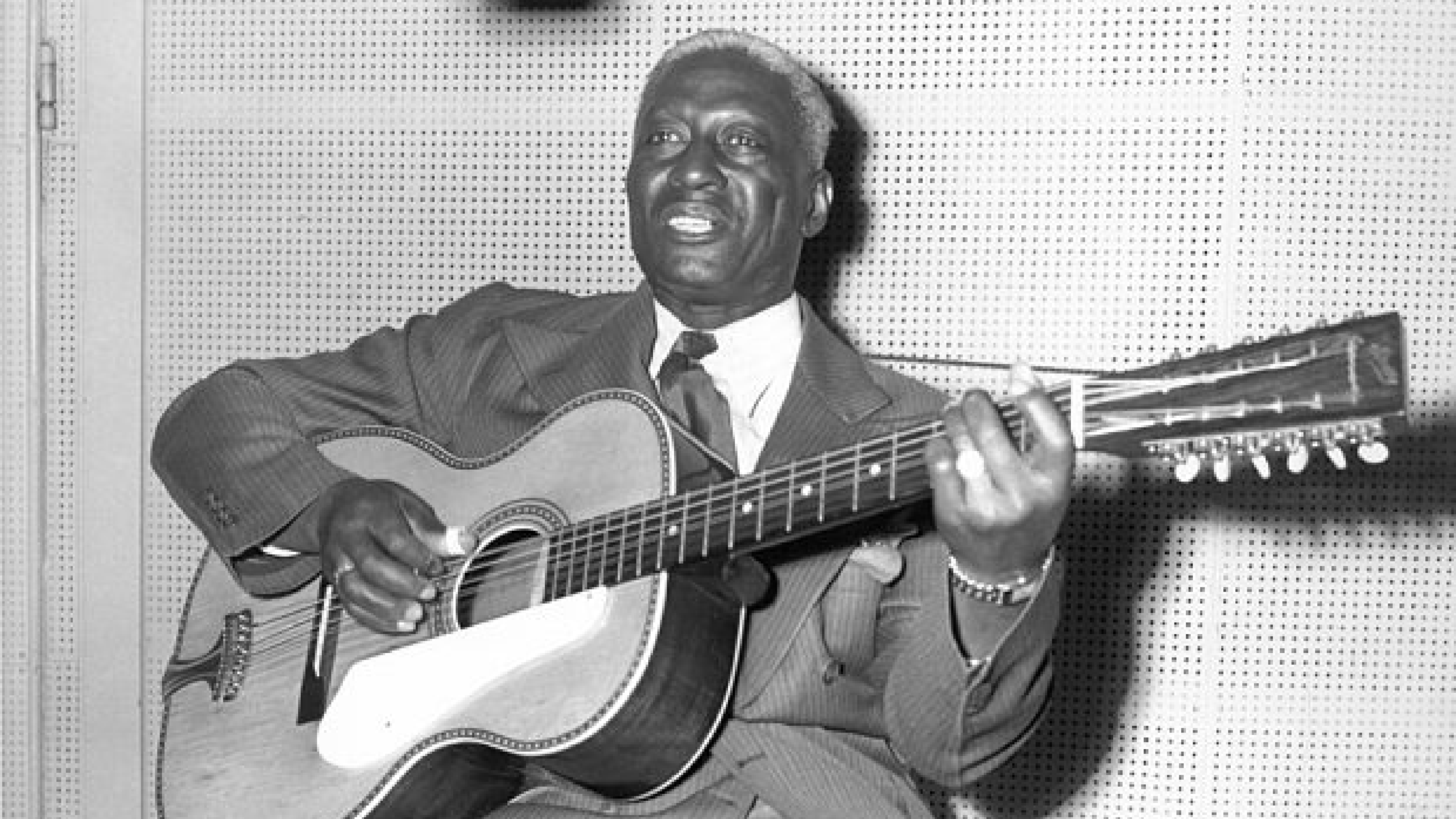
Echoes of the 12-String: The Enduring Sound of Lead Belly
There are artists who shape genres, and then there are artists who shape the conditions that allow genres to exist. Huddie “Lead Belly” Ledbetter belongs to the latter.
To understand Lead Belly is to understand that his music did not emerge from a studio, a label, or a scene—it emerged from lived experience. His sound was not crafted for mass appeal. It was forged in environments where music functioned as communication, survival, and memory all at once. Fields, prison yards, juke joints, and front porches were his stages long before concert halls or recording sessions ever entered the picture.
At the center of that sound was his twelve-string guitar.
At a time when most musicians relied on the standard six-string, Lead Belly’s choice of a twelve-string instrument was both practical and expressive. The additional strings gave his playing a fullness that allowed him to function as both rhythm and lead. In open spaces—where amplification was nonexistent—this mattered. His guitar had to carry. And it did.
But the instrument alone does not explain the impact.
What made Lead Belly singular was his ability to inhabit a song completely. His performances were not distant interpretations; they were embodied. When he sang about labor, you heard labor. When he sang about incarceration, you heard confinement. When he sang about love, it arrived without sentimentality—direct, unguarded, and human.
Many of the songs associated with Lead Belly were not originally written by him in the conventional sense. They existed within oral tradition—passed from voice to voice, generation to generation. What he did was something arguably more important: he preserved, reinterpreted, and, in many cases, defined the versions that would endure.
This is particularly evident in songs like “Midnight Special,” “Pick a Bale of Cotton,” and “Where Did You Sleep Last Night?” Each existed before him. But it is his recordings—his phrasing, his cadence, his structure—that became the reference point for decades of artists to follow.
When folklorists John and Alan Lomax encountered Lead Belly in Angola Prison in 1933, they recognized immediately that they were not simply recording a musician—they were documenting a living archive. Through their work with the Library of Congress, hundreds of Lead Belly’s songs were recorded, many for the first time in history.
Those recordings would become foundational.
Bob Dylan often spoke about the moment he first heard Lead Belly. It wasn’t just admiration—it was recognition.
“Somebody I’d never seen before handed me a Lead Belly record with the song ‘Cotton Fields’ on it,” Dylan recalled. “And that record changed my life right then and there.”
That statement is not hyperbole. It is lineage.
Dylan’s early work—the rawness of it, the willingness to center narrative over polish—owes a clear debt to Lead Belly. The same can be said of Woody Guthrie, who didn’t just study Lead Belly’s music but shared space with him. Guthrie understood, perhaps more than most, that Lead Belly’s songs were not simply songs—they were documents.
“He was a real man, and his music was real. That’s why it stuck.”
— Woody Guthrie
As American music evolved, Lead Belly’s influence did not fade—it transformed.
In the 1960s, as the folk revival gained momentum, his recordings found new audiences. Artists like Joan Baez and Pete Seeger carried his songs into protest movements, where they became tools for collective expression. His music, rooted in earlier struggles, found relevance in contemporary ones.
By the 1990s, his reach extended into entirely different sonic territories.
Kurt Cobain’s performance of “Where Did You Sleep Last Night?” during Nirvana’s MTV Unplugged session remains one of the most haunting reinterpretations of Lead Belly’s work. Cobain introduced the song as one by his “favorite performer,” bringing Lead Belly into the consciousness of a generation that may have otherwise never encountered him.
The performance is striking not because it imitates Lead Belly, but because it preserves the emotional intensity at the core of the song. It demonstrates something essential about Lead Belly’s music: it does not require preservation in form—it requires preservation in feeling.
“I’d like to play a song by my favorite performer… Lead Belly.”
— Kurt Cobain
This ability to move across time, genre, and audience is what defines true legacy.
Even now, Lead Belly’s influence continues to surface in contemporary music. When Beyoncé incorporated elements of “Black Betty” into her Cowboy Carter era, it was not an isolated reference. It was part of a larger continuum—one that connects early American folk traditions to modern global platforms.
This is how cultural memory operates. It does not remain static. It circulates, reappears, and recontextualizes itself in new forms.
Lead Belly’s music has always been part of that circulation.
But to reduce his legacy to influence alone would be incomplete.
His work exists not just as a foundation for other artists, but as a record of a specific time, place, and experience. Songs like “Bourgeois Blues” offer direct commentary on racial injustice, documenting discrimination in Northern cities at a time when such realities were often dismissed or ignored.
In that sense, Lead Belly was not only an artist—he was a witness.
His recordings hold within them the textures of a life lived under conditions that demanded both endurance and expression. They carry the weight of labor, the tension of confinement, and the complexity of survival.
And yet, they also carry joy.
They carry humor, rhythm, movement, and moments of lightness that resist the idea that struggle must always be solemn. This duality is part of what makes his work so enduring. It refuses simplification.
Today, the legacy of Huddie Ledbetter continues through the work of his descendants and the ongoing efforts of the Lead Belly Estate. The goal is not only to preserve his recordings, but to contextualize them—to ensure that they are understood not as artifacts, but as living documents.
Because that is what they are.
Lead Belly’s music does not belong solely to the past. It exists in the present, in every reinterpretation, every reference, every moment where his voice finds its way back into the cultural conversation.
The twelve-string still resonates.
The songs still travel.
And the story is still being told.
Leave a Reply